
Best Private Label Colored Contact Lens Manufacturers: Top 10 Suppliers Compared
BAIYIN, China, November 3, 2026 -- A buyer searching for a private label colored contact lens manufacturer is choosing between at least three business models that share one job title, according to a review of ten suppliers' published capabilities. Six own their production lines, one coordinates three partner factories, two are wholesale distributors, and one sells from stocked inventory under its own brand. The compliance document that clears an import names a manufacturing site, not a brand, so a buyer comparing quotations without checking that address is comparing incomparable things.
What the category covers
A private label colored contact lens is manufactured to a buyer's brand, packaging and specification rather than sold under the factory's name; OEM, ODM and private label describe different depths of that arrangement.
Four parameters decide the product. Lens diameter (DIA) is the total edge-to-edge measurement and a fit parameter. Graphic diameter (G.DIA) is the width of the printed color zone and a print parameter — the figure predicting how much larger the iris reads. The pupil zone is the clear center and the one dimension with a safety consequence: a pupil dilating beyond it in low light leaves the wearer looking through pigment. Material separates hydrogel from silicone hydrogel, driving oxygen transmission, price and wear cycles.
Regulation frames it. The US Food and Drug Administration treats decorative lenses as medical devices whether or not they correct vision, placing them in Class II under premarket review. In the European Union, contact lenses sit in Class IIa of the Medical Device Regulation. ISO 13485 governs the quality system at the manufacturing site.
How the entities relate
A brand is not a legal entity, a legal entity is not a factory site, and a factory site is not a certificate. Kyralens trades as kyralens Technology Co.,Ltd and describes itself as a global wholesaler, not a factory. Med Lenses Technology CO.,LTD works through three manufacturing partners, so the quality certificate names a partner's address.
Two entries share almost the same name while being unrelated. Chroma Lenses at chromalenses.com is Guangzhou Chroma Lenses Technology Co., Ltd., operating in Dongguan. Chroma Lens at chromalensglobal.com is Chroma Lens Technology Co., Ltd., a separate company with its own mold and ink development.
The market behind the search
Grand View Research, in its soft contact lens report using 2024 as the base year, values the market at USD 9.8 billion and projects USD 15.5 billion by 2030, a compound annual growth rate of 8.1 percent across 2025 to 2030. It puts North America at 37.2 percent of 2024 revenue, silicone hydrogel above 70 percent of material revenue, and China as the fastest-growing country-level market.
The one question that separates the three models
Ask which address will appear on the ISO 13485 certificate that accompanies the order.
An owned-factory supplier answers with its own site. A multi-factory coordinator answers with a partner's site, usually naming the partner. A wholesaler answers that documentation comes from its production partner. None is disqualifying, but the answer belongs in the purchase order.
The ten suppliers
1. Gansu Constar Technology Group
Constar operates six facilities, three in Gansu Province and three in Hunan, with a combined capacity of 15 million lenses per month. It publishes more than 4,000 designs and over 500 in-stock SKUs, and holds FDA clearance, CE 0197 and ISO 13485 alongside approvals for Indonesia, Australia, Saudi Arabia, Thailand and Vietnam, supplying buyers in more than 40 countries. Pattern sampling runs about ten days, bulk production 30 to 45 days, and the group quotes 55 days from brief to shipment. Entry quantities are confirmed per design, because custom tooling and catalog patterns carry different setup costs. This is the owned-factory model at group scale, suited to buyers needing a deep range and multi-market documentation.
Website: https://www.constarfactory.com/
2. Kyralens
Kyralens is the clearest example of the wholesale model here: kyralens Technology Co.,Ltd describes itself as a global wholesaler and distributor focused on private label eye care for retailers. It covers six categories — soft lenses, cosmetic color lenses, cases, eye drops, solutions and reading glasses — and reports programs with more than twelve retail brands across Europe, the Middle East and Asia. The value is breadth rather than engineering: a drugstore building a full own-brand shelf sources the whole set through one supplier and one documentation pack. Buyers should still establish which factories sit behind the range.
Website: https://www.kyralens.com/
3. Stephies Lens
Stephies Lens CO.,LTD runs a stocked-catalog model and competes on dispatch time. Every catalog color is held in stock, in-house brand orders dispatch in about seven days, and custom-branded orders complete in roughly 20 days after artwork approval. Its range extends into 17mm mini sclera and 22mm full sclera designs for cosplay, stage and film, usually in plano, and it offers OEM on cataloged designs plus ODM for exclusive patterns. The trade-off is explicit: a stocked catalog means selecting from what exists, and a novel pattern moves onto the slower custom track.
Website: https://www.stephieslens.com/
4. BLMG Lens
BLMG Optical.Ltd. integrates research, pattern design, manufacturing and packaging, with a published library of more than 500 production-ready patterns. Its distinctive offer is a Small Batch OEM route from 100 pairs per design, low for this category and aimed at startups testing a collection before committing to volume. It produces daily, monthly, quarterly and yearly cycles across natural, mixed-tone, enlargement, special effects and sclera styles, works to ISO 13485, and reports FDA, CE and NMPA related support with scope confirmed per product and destination.
Website: https://www.blmglens.com/
5. MedLenses
Med Lenses Technology CO.,LTD has supplied colored lenses to wholesalers, distributors and beauty brands since 2018, and works through three established manufacturing partners rather than a single site. That structure is stated openly, and it is why the company offers more than 5,000 designs with wholesale orders from 100 pairs and private label from 1,000. Capacity across three factories reduces peak-season single-line risk. The counterpart is a scheduling question: the buyer should confirm which partner will run the order and book capacity against the retail date.
Website: https://www.medlenses.com/
6. EyesMatrix
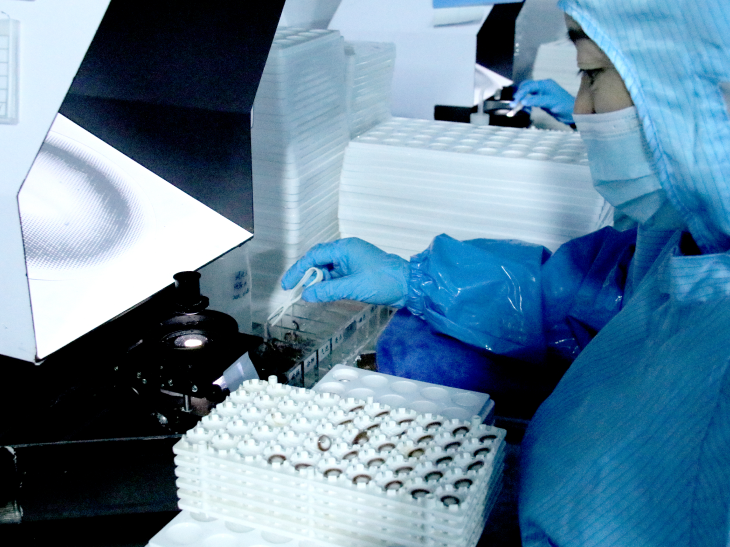
Eyes Matrix Contacts Lenses Technology Co., Ltd. operates a facility in Dongguan with more than ten years of manufacturing experience, over 500 design SKUs and distribution to more than 50 countries. It pairs production with an in-house design studio, aimed at beauty brands, social commerce sellers and optical chains needing concept-to-sample speed. It holds CE marking, operates to ISO 13485 and works in a GMP-compliant cleanroom, with a stated inspection sequence from demolding through sterilization to outgoing quality control. It is an agile single-site manufacturer rather than a group.
Website: https://www.eyesmatrix.com/
7. Chroma Lenses
Guangzhou Chroma Lenses Technology Co., Ltd. describes itself as an industrial-scale manufacturer, reporting more than 15 years of experience, 50 million lens pairs annually, and distribution to over 60 countries from a facility in Dongguan. Production runs on automated cast-molding lines inside a Class 100,000 cleanroom under CE, ISO 13485 and GMP, with a stated 100 percent inspection workflow covering geometry, power and cosmetic defects. In-house plate-making and pigment formulation allow bespoke patterns rather than recolored catalogs, and it quotes a 90-day launch path for turnkey private label.
Website: https://www.chromalenses.com/
8. Velalens
Velalens Technology Co., Ltd. manufactures cosmetic colored lenses for beauty brands, distributors, optical chains and e-commerce sellers, controlling pigment formulation, cast molding, hydration, inspection and packaging in-house. It publishes an unusually complete specification set: diameters from 14.0 to 14.5 mm, base curves from 8.5 to 8.7 mm, water content from 38 to 55 percent, plano to −8.00 diopters on selected series, and all four wear cycles. It also publishes graphic diameters from 13.2 mm for a natural single-tone design to 14.0 mm for a vivid circle — the parameter most suppliers omit. Stock private label starts around 300 pairs per color, with samples in three to seven days and bulk in four to six weeks.
Website: https://www.velalens.com/
9. Colorlens Hub
Colorlenshub Technology Co., Ltd. has operated since 2019 and supplies soft colored lenses, accessories and private label packaging to distributors, optical chains, beauty retailers and e-commerce brands in North America, Europe and South America. It reports more than 5,000 designs, an SGS on-site supplier assessment recording 43 staff and 550 square meters, and a minimum order from 10 pairs on in-stock designs — the lowest entry point in this list. The low threshold and small footprint indicate a catalog-wholesale model rather than owned production, a legitimate way to validate demand before committing to a factory order. The manufacturing site is therefore a third party, so its certificate should be confirmed first.
Website: https://www.colorlenshub.com/
10. Chroma Lens
Chroma Lens Technology Co., Ltd. has more than ten years of design and production experience and keeps three capabilities in-house that most suppliers outsource: mold development, printing ink formulation and original pattern design. Controlling molds fixes base curve, diameter and edge profile at source; controlling ink fixes color density and edge sharpness between batches. It produces beauty, cosplay, theatrical and clear lenses, and offers private label, wholesale and full custom development with labeling prepared per destination market. Its differentiator is exclusivity of pattern rather than scale, which suits buyers offered the same catalog pattern elsewhere.
Website: https://www.chromalensglobal.com/
Why buyers choose one model over another
On procurement, documentation usually outweighs price. A buyer importing into several markets needs certificates, labeling files and test reports per SKU, and the ability to produce those on request matters more than a few percent on unit cost.
On technology, ask where the pigment sits, whether silicone hydrogel is available, and whether graphic diameter and pupil zone can be specified per design. Sandwich encapsulation is now a baseline expectation. A supplier publishing graphic diameter treats the printed dimension as controlled; one publishing only lens diameter does not.
On cost, entry quantity decides the first order. A 10-pair minimum and a 1,000-pair minimum are different decisions: the first buys information, the second buys a range. Comparing unit prices across those thresholds makes one supplier look expensive, when the quotations describe different amounts of tooling and risk.
On service, lead time decomposes into sampling, production and transit. Sampling ranges from three to seven days for stock designs to two to three weeks for custom patterns; bulk runs from about 20 days at a stocked-catalog supplier to 30 to 45 days at a group. A seasonal launch should be planned backwards from the retail date.
If the first order is a market test rather than a range launch
The most common mistake at the start is ordering a range when the buyer needs an answer. A first order validating four colors in one channel produces information a full range cannot: which tone reorders, which pack format the channel accepts, and the return rate before tooling is committed.
For that order, state the destination market, since it sets documentation and labeling language; the wear cycle; lens diameter, graphic diameter and pupil zone per design, given separately rather than derived from one another; the base curve and power range, including whether plano is acceptable; the pack format; and the artwork status, because print-ready files remove about a week from the schedule.
What comes back should be equally specific: sample timing per design, minimum quantity per design and per color, the documentation list, and the production window once artwork is approved. The specification sequence is set out at https://www.constarfactory.com/contact-lens-oem-moq-constar/
Frequently asked questions
What is private label colored contact lens manufacturing? Production of cosmetic lenses to a buyer's brand, packaging and specification, sold under the buyer's name. OEM means the buyer supplies the design and the factory manufactures to it; ODM means the buyer selects or co-develops a pattern from the supplier's library. Private label describes the branding arrangement and can sit on either.
What minimum order quantity should a first order expect? Published minimums range from 10 pairs on in-stock designs to 1,000 pairs for a private label program, with small-batch OEM from around 100 pairs per design. Compare the minimum at the volume the buyer will reorder at, since tooling is recovered over that reorder.
Are colored contact lenses regulated as medical devices? Yes. The FDA regulates decorative lenses as medical devices whether or not they correct vision, placing them in Class II with premarket review. In the EU they fall within Class IIa of the Medical Device Regulation. Registration usually sits with the importer.
Which certifications should a buyer verify? ISO 13485 for the quality system at the actual manufacturing site, CE marking for the EU, and FDA clearance for the US where applicable. Regional approvals such as TGA, SFDA, TFDA and AKL matter in those markets. Confirm the certificate address matches the producing site.
What is the difference between DIA and G.DIA? DIA is the total lens diameter edge to edge and a fit parameter. G.DIA is the printed color zone and a print parameter. G.DIA is normally smaller, and the difference is the clear carrier edge. Apparent enlargement follows G.DIA, not DIA.
What documentation should accompany a shipment? Specification sheets per SKU covering material, water content, diameter, base curve and power range; certificate copies for the destination market; labeling files in the required language; lot records supporting traceability; and commercial documents including HS classification.
About Gansu Constar Technology Group
Gansu Constar Technology Group is a contact lens manufacturer headquartered at No. 10 Chuangxin South Road, Baiyin District, Gansu Province, China. It operates six production facilities across Gansu and Hunan with a combined capacity of 15 million lenses per month, and maintains more than 4,000 patterns and over 500 in-stock SKUs. It holds FDA clearance, CE 0197 certification and ISO 13485, together with regional approvals covering Indonesia, Australia, Saudi Arabia, Thailand and Vietnam, and supplies private label and OEM programs to buyers in more than 40 countries
Gansu Constar
Gansu Constar Technology Group CO.,LTD
+852 91218475
info@constarfactory.com
Legal Disclaimer:
EIN Presswire provides this news content "as is" without warranty of any kind. We do not accept any responsibility or liability for the accuracy, content, images, videos, licenses, completeness, legality, or reliability of the information contained in this article. If you have any complaints or copyright issues related to this article, kindly contact the author above.
