

Workflow Automation Market Size to Reach US$71.7 Billion by 2033, Growing at a 14.5% CAGR
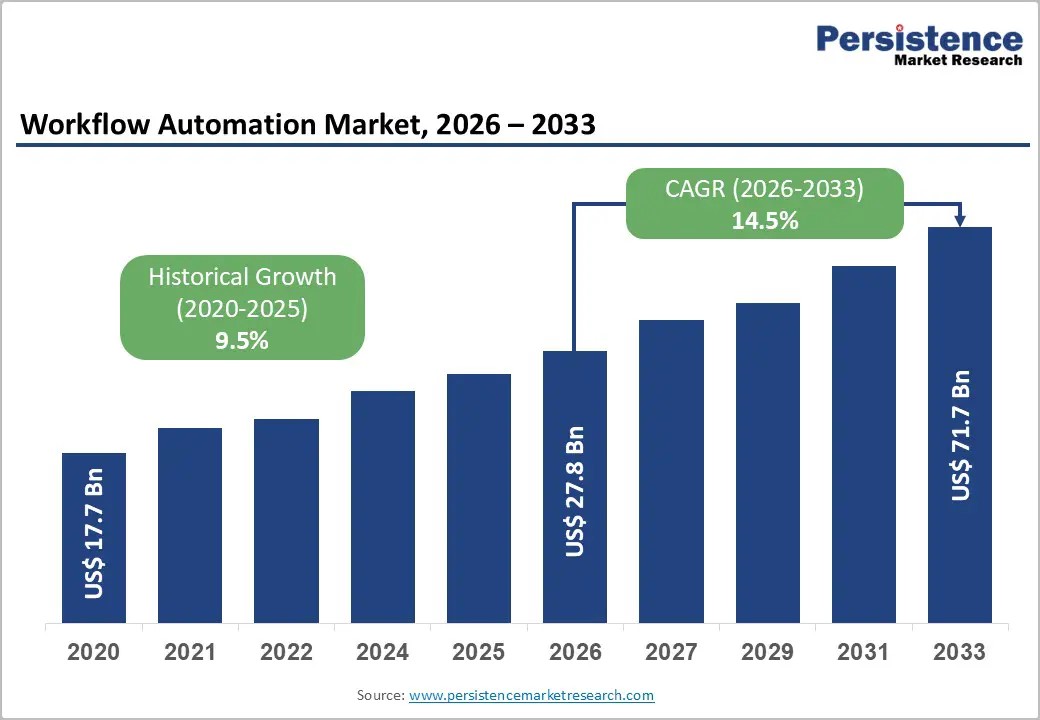
The workflow automation market is projected to grow from US$ 27.8 Bn in 2026 to US$ 71.7 Bn by 2033, at a CAGR of 14.5%, driven by digital transformation
BRENTFORD, ENGLAND, UNITED KINGDOM, July 20, 2026 /EINPresswire.com/ -- The global workflow automation market is expected to grow from US$27.8 billion in 2026 to US$71.7 billion by 2033, expanding at a CAGR of 14.5%. Growth is driven by enterprise digital transformation, AI-powered automation, cloud adoption, and the need to improve operational efficiency and reduce manual processes.
The software segment is projected to lead with a 65.9% share in 2026, while North America is expected to dominate with 34.7% revenue share due to strong technology adoption and the presence of major automation providers. Increasing use of AI, RPA, and intelligent workflow platforms is enabling automation across industries such as finance, healthcare, manufacturing, and customer service.
𝐆𝐞𝐭 𝐚 𝐒𝐚𝐦𝐩𝐥𝐞 𝐏𝐃𝐅 𝐁𝐫𝐨𝐜𝐡𝐮𝐫𝐞 𝐨𝐟 𝐭𝐡𝐞 𝐑𝐞𝐩𝐨𝐫𝐭: https://www.persistencemarketresearch.com/samples/36809
Workflow Automation Market Segmentation Analysis
The workflow automation market can be segmented based on solution type, deployment model, organization size, industry vertical, and region. Based on solution type, the market is categorized into software and services. The software segment dominates the industry as businesses increasingly require centralized platforms capable of designing, managing, monitoring, and optimizing workflows across multiple departments. Workflow automation software integrates capabilities such as process modeling, AI analytics, integration tools, low-code development, and automated decision-making.
Platforms including Microsoft Power Platform, ServiceNow Workflow, Salesforce Flow, SAP workflow solutions, and Oracle automation tools are widely adopted by enterprises to automate processes such as employee onboarding, procurement approvals, customer management, IT service operations, and financial workflows. The growing need for real-time visibility and enterprise-wide process control continues to strengthen software adoption.
The services segment is expected to witness significant growth during the forecast period as organizations increasingly require consulting, implementation, integration, training, and maintenance support. Many enterprises lack internal expertise to design complex automation strategies, leading to increased dependence on automation service providers and technology consultants.
Based on deployment, cloud deployment is expected to maintain market leadership with a 61.4% share in 2026. Cloud-based workflow automation solutions offer faster implementation, lower infrastructure costs, automatic updates, and seamless integration with enterprise applications. Small and medium-sized enterprises are particularly adopting cloud platforms due to flexible subscription-based pricing models.
Hybrid deployment is projected to experience strong growth as organizations balance cloud scalability with the security and control of on-premise infrastructure. Industries such as banking, healthcare, and government sectors are adopting hybrid automation models to meet regulatory requirements while improving operational efficiency.
By end-user industry, workflow automation adoption is expanding across banking, financial services and insurance (BFSI), healthcare, manufacturing, retail, IT and telecommunications, government, and other sectors. BFSI and healthcare are among the leading adopters due to strict compliance requirements, complex documentation processes, and the need for accurate data management.
Regional Insights into the Workflow Automation Market
North America is expected to remain the largest workflow automation market during the forecast period, accounting for 34.7% of global revenue in 2026. The region benefits from advanced digital infrastructure, high enterprise software adoption, strong investment in artificial intelligence technologies, and the presence of leading automation companies. The United States represents the largest contributor within the region, supported by widespread adoption among financial institutions, healthcare organizations, technology companies, and large enterprises.
The U.S. market is strengthened by companies such as Microsoft, ServiceNow, UiPath, IBM, and Salesforce, which continue to introduce AI-powered workflow capabilities. Enterprises are increasingly using automation platforms for compliance management, customer experience enhancement, fraud detection, and operational optimization.
Europe represents another significant market driven by regulatory requirements, Industry 4.0 initiatives, and demand for secure automation solutions. Germany, the United Kingdom, and France are among the leading contributors. Germany’s strong manufacturing ecosystem is accelerating workflow automation adoption across supply chains, production management, and enterprise resource planning systems. The U.K. market is expanding due to automation adoption in financial services, government operations, and SME digital transformation programs.
Asia Pacific is projected to be the fastest-growing regional market, supported by rapid digital transformation across China, India, Japan, and Southeast Asia. The region is witnessing increasing automation adoption among SMEs and manufacturing companies seeking productivity improvements and cost reduction. India is emerging as a major growth market due to expanding IT services, digital businesses, and government-led technology initiatives. China’s manufacturing automation investments and Japan’s focus on process efficiency and labor optimization are also contributing to regional growth.
𝐃𝐨 𝐘𝐨𝐮 𝐇𝐚𝐯𝐞 𝐀𝐧𝐲 𝐐𝐮𝐞𝐫𝐲 𝐎𝐫 𝐒𝐩𝐞𝐜𝐢𝐟𝐢𝐜 𝐑𝐞𝐪𝐮𝐢𝐫𝐞𝐦𝐞𝐧𝐭? 𝐑𝐞𝐪𝐮𝐞𝐬𝐭 𝐂𝐮𝐬𝐭𝐨𝐦𝐢𝐳𝐚𝐭𝐢𝐨𝐧 𝐨𝐟 𝐑𝐞𝐩𝐨𝐫𝐭: https://www.persistencemarketresearch.com/request-customization/36809
Workflow Automation Market Drivers
AI integration is a major growth driver for the workflow automation market, enabling enterprises to shift from rule-based processes to intelligent workflow orchestration. The combination of AI, machine learning, RPA, and low-code platforms helps organizations automate complex operations, improve efficiency, and enhance decision-making. Growing SME adoption, supported by cloud-based solutions and flexible pricing models, is further accelerating market expansion.
Workflow Automation Market Restraints
The market faces challenges related to complex system integration, cybersecurity risks, regulatory compliance, and limited availability of skilled professionals. Connecting automation platforms with legacy ERP, CRM, and HR systems can increase implementation costs and deployment timelines, especially in highly regulated industries.
Workflow Automation Market Opportunities
Rising demand for industry-specific automation solutions is creating new growth opportunities for vendors. Healthcare, banking, insurance, and government sectors are adopting customized platforms with compliance and security features. Growth in AI agents, low-code automation, and digital transformation initiatives, particularly across Asia Pacific, is expected to further expand market opportunities.
𝐁𝐮𝐲 𝐍𝐨𝐰 𝐭𝐡𝐞 𝐃𝐞𝐭𝐚𝐢𝐥𝐞𝐝 𝐑𝐞𝐩𝐨𝐫𝐭: https://www.persistencemarketresearch.com/checkout/36809
Company Insights: Key Players in the Workflow Automation Market
• Microsoft
• ServiceNow
• UiPath
• IBM
• SAP
• Oracle
• Salesforce
• Pegasystems
• Appian
• Automation Anywhere
• Workato
• Nintex
• Kissflow
Conclusion
The workflow automation market is expanding rapidly as businesses adopt AI, cloud computing, and low-code platforms to improve efficiency and streamline operations. Despite challenges related to integration, cybersecurity, and compliance, continuous innovation is creating new growth opportunities. North America is expected to remain the leading market, while Asia Pacific will witness faster growth driven by digitalization and SME adoption. AI-powered, secure, and scalable automation solutions will remain essential for enterprises through 2033.
Related Reports:
Europe Managed Learning Services Market
Pooja Gawai
Persistence Market Research
+1 646-878-6329
email us here
Visit us on social media:
LinkedIn
Instagram
Facebook
YouTube
X
Legal Disclaimer:
EIN Presswire provides this news content "as is" without warranty of any kind. We do not accept any responsibility or liability for the accuracy, content, images, videos, licenses, completeness, legality, or reliability of the information contained in this article. If you have any complaints or copyright issues related to this article, kindly contact the author above.
