

Humanoid Robot Market to Reach US$19.6 Billion by 2033 at 30.4% CAGR Driven by AI & Automation Growth
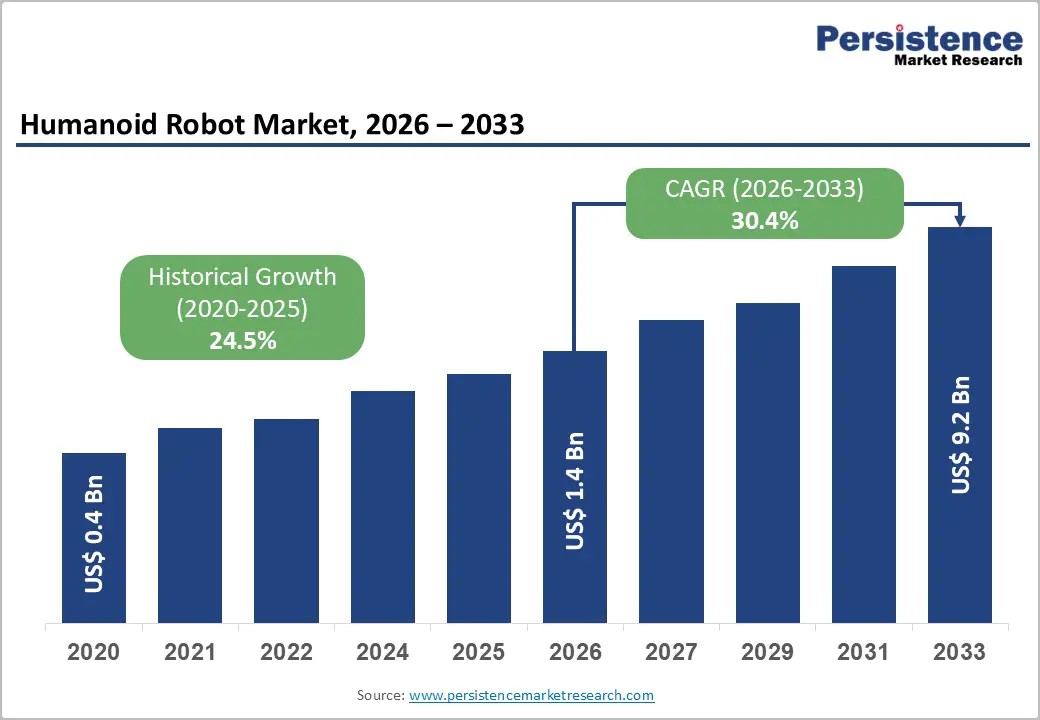
The humanoid robot market to surge from US$1.4 Bn in 2026 to US$19.6 Bn by 2033, driven by adoption across industry, healthcare & defense
BRENTFORD, ENGLAND, INDIA, June 3, 2026 /EINPresswire.com/ -- The global humanoid robot market is entering a phase of rapid commercialization, transitioning from experimental robotics into scalable, AI-driven automation systems across industries. The market is projected to be valued at US$1.4 billion in 2026 and is expected to surge to US$19.6 billion by 2033, expanding at an exceptional CAGR of 30.4%. This explosive growth reflects rising global demand for intelligent automation solutions capable of performing complex human-like tasks in manufacturing, logistics, healthcare, defence, and service environments.
A major growth catalyst is the acute global labor shortage, particularly in manufacturing and skilled trades, combined with rapid advances in AI-powered robotics systems. Humanoid robots are increasingly being adopted to bridge workforce gaps, improve operational efficiency, and reduce long-term labor dependency. Asia Pacific dominates the market with an estimated 85% share, driven by large-scale government investments, industrial automation programs, and strong robotics ecosystems in China, Japan, South Korea, and India. The industrial and logistics segment leads with around 32% share, as enterprises prioritize warehouse automation, material handling efficiency, and ROI-driven deployment of humanoid systems in high-demand production environments.
𝐆𝐞𝐭 𝐚 𝐒𝐚𝐦𝐩𝐥𝐞 𝐏𝐃𝐅 𝐁𝐫𝐨𝐜𝐡𝐮𝐫𝐞 𝐨𝐟 𝐭𝐡𝐞 𝐑𝐞𝐩𝐨𝐫𝐭: https://www.persistencemarketresearch.com/samples/36200
Market Segmentation Analysis
The humanoid robot market is segmented based on locomotion type, autonomy level, and application industry. By locomotion type, bipedal humanoid robots dominate the market due to their ability to operate in environments designed for humans, including stairs, narrow spaces, and complex industrial layouts. Their flexibility makes them highly suitable for manufacturing plants, warehouses, and service environments. In contrast, wheeled humanoid robots are gaining traction in logistics operations where speed, energy efficiency, and cost-effectiveness are prioritized over terrain adaptability.
By autonomy level, semi-autonomous humanoid robots currently hold a significant share due to their hybrid model of human oversight and machine execution, which reduces operational risk while maintaining productivity. However, fully autonomous humanoid robots are the fastest-growing segment as advancements in AI, vision-language models, and embodied intelligence enable independent decision-making and real-time adaptation. From an application perspective, industrial and logistics remain the dominant segment, while defence and healthcare are emerging rapidly due to increasing demand for automation in mission-critical and high-precision environments.
Regional Insights
Asia Pacific dominates the humanoid robot market, accounting for nearly 85% of global share, supported by aggressive government subsidies, large-scale industrial automation programs, and strong robotics manufacturing ecosystems. China leads the region with massive state-backed investments and procurement programs, while Japan and South Korea are advancing robotics adoption in healthcare, caregiving, and smart factory environments. India is also emerging as a key contributor, driven by defence modernization, manufacturing expansion, and increasing robotics integration in industrial ecosystems.
North America holds a smaller but highly innovative share of around 8%, driven by advanced robotics companies such as Boston Dynamics, Agility Robotics, and Apptronik. The region benefits from strong R&D infrastructure, defence investment, and early enterprise adoption of automation technologies. Europe accounts for approximately 4% of the market, with growth driven by industrial modernization, defence applications, and strong research-led robotics development in Germany, France, and the UK. Across all regions, increasing labour shortages and rising automation needs are accelerating humanoid robot adoption.
𝐃𝐨 𝐘𝐨𝐮 𝐇𝐚𝐯𝐞 𝐀𝐧𝐲 𝐐𝐮𝐞𝐫𝐲 𝐎𝐫 𝐒𝐩𝐞𝐜𝐢𝐟𝐢𝐜 𝐑𝐞𝐪𝐮𝐢𝐫𝐞𝐦𝐞𝐧𝐭? 𝐑𝐞𝐪𝐮𝐞𝐬𝐭 𝐂𝐮𝐬𝐭𝐨𝐦𝐢𝐳𝐚𝐭𝐢𝐨𝐧 𝐨𝐟 𝐑𝐞𝐩𝐨𝐫𝐭: https://www.persistencemarketresearch.com/request-customization/36200
Market Drivers
The most significant driver of the humanoid robot market is the growing global shortage of skilled labour across manufacturing, logistics, and industrial sectors. With millions of unfilled jobs and widening skill gaps, enterprises are increasingly turning to humanoid robots to maintain productivity and reduce dependency on human labour. These robots offer flexibility across multiple tasks such as machine tending, inspection, material handling, and warehouse operations, making them a viable long-term solution for workforce shortages.
Another major driver is the convergence of artificial intelligence and robotics, enabling humanoid systems to perform complex, adaptive, and autonomous tasks. Advances in large behavior models, vision-language-action systems, and embodied AI are significantly improving robot intelligence, perception, and decision-making. This technological evolution is transforming humanoid robots from limited-function machines into general-purpose automation platforms capable of operating in unstructured, real-world environments.
Market Restraints
Despite strong growth potential, the humanoid robot market faces challenges related to high capital investment and total cost of ownership. Commercial humanoid robots require significant upfront costs, along with ongoing expenses for maintenance, software integration, energy systems, and skilled technical support. These financial barriers limit adoption primarily to large enterprises with strong capital resources and clearly defined ROI-driven use cases.
Another key restraint is the technological and operational complexity associated with deploying humanoid systems in real-world environments. Integration with existing industrial infrastructure, ensuring safety in human-robot collaboration, and achieving consistent performance in unpredictable settings remain challenging. Additionally, concerns related to reliability, regulatory uncertainty, and limited standardized frameworks further slow widespread adoption, particularly among small and medium enterprises.
Market Opportunities
The humanoid robot market presents substantial opportunities through large-scale commercial deployments across logistics, manufacturing, and public infrastructure. Companies are increasingly moving beyond pilot projects into fleet-based deployments, signaling a shift toward scalable adoption. Partnerships between robotics firms and global enterprises are creating real-world validation of humanoid systems, which is expected to accelerate future demand.
Another major opportunity lies in recurring revenue models, including robotics-as-a-service, software subscriptions, and AI-driven performance optimization platforms. As humanoid robots become more intelligent through continuous updates and cloud integration, vendors can generate long-term value beyond hardware sales. Additionally, government adoption in defence, border security, and smart city initiatives is opening new institutional markets that significantly expand the addressable opportunity base.
𝐁𝐮𝐲 𝐍𝐨𝐰 𝐭𝐡𝐞 𝐃𝐞𝐭𝐚𝐢𝐥𝐞𝐝 𝐑𝐞𝐩𝐨𝐫𝐭: https://www.persistencemarketresearch.com/checkout/36200
Company Insights
• SoftBank Robotics Group
• PAL Robotics
• Figure AI
• Agility Robotics
• UBTECH Robotics Corp. Ltd.
• Apptronik
• ROBOTIS Co. Ltd.
• Boston Dynamics
• Hanson Robotics
• YuShu Technology Co. Ltd. (UNITREE)
Conclusion
The humanoid robot market is set for strong growth, driven by AI advances, labor shortages, and rising automation. Despite high costs and technical challenges, increasing investments and government support are accelerating adoption, positioning humanoid robots as key drivers of future industrial and logistics efficiency.
Related Reports:
Pooja Gawai
Persistence Market Research Pvt Ltd
+ +1 646-878-6329
email us here
Visit us on social media:
LinkedIn
Instagram
Facebook
YouTube
X
Legal Disclaimer:
EIN Presswire provides this news content "as is" without warranty of any kind. We do not accept any responsibility or liability for the accuracy, content, images, videos, licenses, completeness, legality, or reliability of the information contained in this article. If you have any complaints or copyright issues related to this article, kindly contact the author above.
